

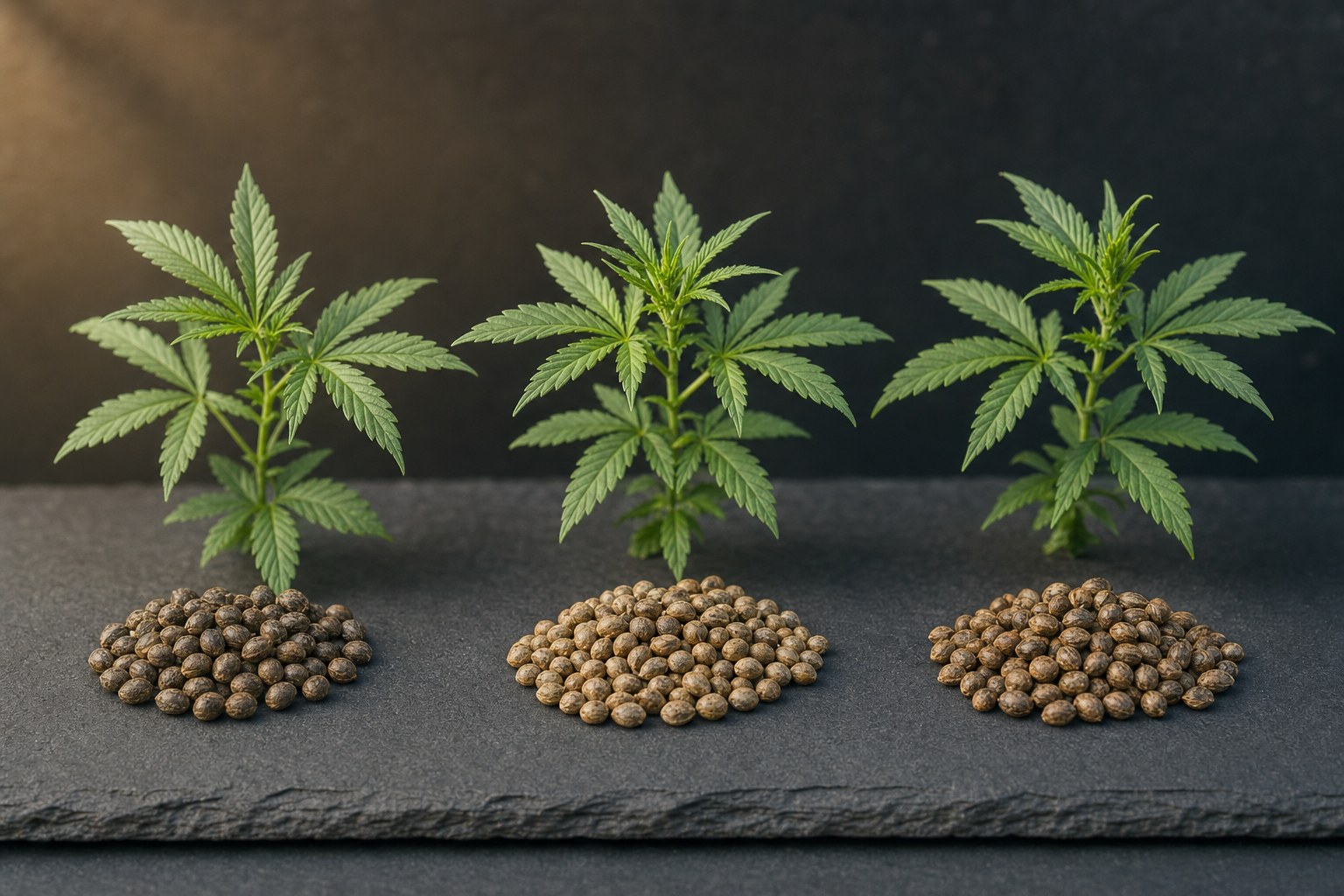
For most Australian growers comparing feminised vs autoflower seeds, feminised seeds offer greater control and training flexibility, while autoflowers offer speed, compact growth and seasonal flexibility. Regular seeds are generally best for growers who want both male and female plants for selection or breeding. The right choice depends on space, timing, climate and experience.
Key takeaways
- Feminised seeds are bred to produce female plants at a very high rate, making them practical when growers want to use their available space efficiently.
- Autoflower seeds begin flowering according to age rather than a major change in daily light hours. They are often compact and quick, but their short vegetative stage leaves less time to recover from mistakes.
- Regular seeds can produce male or female plants. They suit selection, pollen projects and growers who value access to both sexes.
- Autoflower describes a flowering habit, while feminised describes the expected sex ratio. Many autoflower seeds sold for home growing are also feminised.
- Australian climate, latitude, humidity, frost timing and local rules should all influence the final choice.
Feminised vs autoflower vs regular seeds at a glance
The three labels do not describe exactly the same biological feature. Feminised and regular refer mainly to the expected sex of the resulting plants. Autoflower refers to how flowering begins. In everyday seed comparisons, however, growers commonly use the three terms as practical categories.
Feminised photoperiod plants usually require longer nights to begin flowering. Outdoors, this shift happens as daylight decreases after summer. Indoors, a grower changes the lighting schedule. Autoflowers flower after reaching a certain age, even under long days. Regular photoperiod seeds behave like standard seasonal plants but may produce either males or females.
What are feminised seeds?
Feminised seeds are produced through controlled pollination methods designed to minimise male offspring. A packet should therefore produce female plants at a high rate, although biology is never absolutely uniform. Environmental stress, unstable genetics or unusual plant expression can still affect an individual result.
Most feminised seeds are photoperiod varieties. They remain in vegetative growth while days are long and move towards flowering when uninterrupted darkness increases. This gives indoor growers control over plant size before flowering. Outdoor growers can use the longer spring and summer vegetative period to build larger plants where climate, privacy and space allow.
The main advantage is efficient use of containers, growing medium, light and room. Growers do not normally need to raise a large group simply to identify and remove males. Feminised plants also suit training methods that require several weeks of shaping. Their timing is generally more forgiving than the rapid life cycle of an autoflower.
What are autoflower seeds?
Autoflower seeds produce plants that begin flowering primarily according to age. Their life cycle often moves quickly, with flowering starting only a few weeks after emergence. Exact timing varies by cultivar, environment and plant health, so catalogue estimates should be read as guides rather than promises.
Many autoflowers stay relatively compact. This can make them useful for balconies, courtyards, small tents or discreet garden positions, subject to local requirements. Their ability to flower under long daylight also creates more options for fitting a crop into warm periods outside the traditional late-summer flowering season.
Speed has a trade-off. Because an autoflower has limited vegetative time, root restriction, overwatering, harsh training or nutrient stress early in life can reduce its final size. It cannot simply be held in vegetative growth for extra weeks. A gentle, well-planned start is therefore particularly valuable.
What are regular seeds?
Regular seeds can produce male or female plants in broadly mixed proportions. Growers usually need to identify sex as plants mature, then separate unwanted males before pollen spreads. This requires additional room and observation compared with growing feminised seed.
Regular seeds remain important for breeding and plant selection. Male plants allow growers to assess growth structure, vigour, aroma from stems and leaves, flowering timing and pollen characteristics. Female siblings can be assessed alongside them, giving a wider pool for a planned seed project.
For a grower whose only goal is an unpollinated female harvest, regular seeds may add work and consume valuable space. For someone interested in preserving varied plant expressions or making deliberate crosses, that variation is the main attraction.
Key differences between feminised, autoflower and regular seeds
Flowering triggers and timing
Photoperiod feminised and regular plants respond mainly to the length of uninterrupted darkness. Outdoors in Australia, they generally grow through spring and summer before flowering as nights lengthen. Latitude and cultivar sensitivity affect the exact transition. Far-northern conditions may produce very different timing from Tasmania or elevated inland districts.
Autoflowers follow an age-led schedule. Long summer days do not hold them in vegetative growth indefinitely. This allows several possible sowing windows in frost-free climates, although low light, cold nights or extreme heat can still limit performance. Fast does not mean unaffected by season.
Feminised photoperiod plants offer more control over timing indoors because the grower chooses when to shorten the light cycle. Regular photoperiod plants offer the same timing control, but sex identification adds another management step.
Plant management and predictability
Feminised seed gives useful predictability where every pot matters. Photoperiod plants can be topped, tied, pruned and allowed time to fill a canopy. If growth slows after repotting or mild stress, the vegetative period can often be extended indoors.
Autoflowers favour early consistency. Many growers use light bending rather than repeated cutting, particularly once flowering is close. Transplanting should be planned carefully because a prolonged pause can use a meaningful part of the plant’s short life cycle. Starting in the final container is a common approach where conditions allow.
Regular plants require enough capacity to grow several candidates until sex becomes visible. Once males are identified, decisions must be made promptly if seedless flowers are the objective. Growers should also inspect all plant types regularly, as sex expression and stress responses can vary.
Space, seasonal flexibility and experience level
Small spaces often favour autoflowers, but the label alone does not guarantee a tiny plant. Container volume, cultivar structure, light intensity and environment all influence size. A vigorous autoflower in a large pot can still become substantial, while a photoperiod plant can be kept small by limiting vegetative time and using training.
Feminised photoperiod seeds are often easier for new indoor growers who want time to learn watering and canopy management. Autoflowers simplify the lighting schedule but demand better timing from the start. Regular seeds generally require the most space because not every plant will suit a female-flower harvest.
For outdoor growing, autoflowers can add seasonal flexibility. A crop may finish before humid late-summer weather in some regions, or fit between cold periods in others. Feminised photoperiod plants make better use of a full outdoor season when the aim is larger plants.
Breeding potential and plant selection
Regular seeds provide the clearest starting point for traditional selection because both sexes are represented. A grower can compare siblings, retain promising parents and explore a broader range of expressions. This work needs isolation, careful labelling and deliberate pollen handling.
Feminised seeds can also show variation and may be used in specialised breeding projects, but they are usually chosen for straightforward female cultivation. Feminised autoflowers are similarly convenient for rapid, compact grows rather than projects requiring male plants.
Selection still matters even when every seed is expected to be female. Germination speed, branching, internode spacing, aroma, resilience and finishing time can differ among siblings. Seed category improves planning, but it does not make every plant identical.
Which seed type suits different Australian growers?
When feminised seeds may be the practical choice
Choose feminised photoperiod seeds when female plant predictability and control over vegetative growth are priorities. They suit growers with limited plant numbers, those planning structured training, and outdoor gardeners able to use a full spring-to-autumn season.
They may also suit first-time indoor growers who want room to correct watering, repotting or training issues before changing the light cycle. The longer timeline requires patience, and outdoor plants may become large if sown early in warm districts.
When autoflower seeds may suit a shorter window or limited space
Choose autoflowers when the available warm-weather window is short, the growing area has limited height, or a rapid finish is more valuable than extensive training. They can suit regions with an early autumn chill, provided sowing is timed so the main flowering period receives strong light and suitable temperatures.
Autoflowers can also be the better alternative in a feminised vs autoflower decision when growers cannot provide strict darkness indoors. Many can remain under a consistent long-day schedule from emergence to harvest. However, light leaks are not the only environmental issue: heat, airflow, humidity and root health remain important.
Choose regular seeds when breeding, maintaining broad variation or evaluating male and female plants is the main goal. They are less space-efficient for a simple flower run, but they offer options the other categories generally do not.
Australian grow calendar and regional notes
Temperate southern regions
In Victoria, Tasmania, southern South Australia and cooler parts of New South Wales and Western Australia, outdoor photoperiod plants are commonly started in spring after damaging cold has eased. They grow through summer and flower as nights lengthen. Autoflowers generally perform best across the brightest, warmest part of late spring and summer. Late sowing can expose flowers to cool, damp autumn conditions.
Subtropical eastern regions
South-east Queensland and northern coastal New South Wales have longer warm periods, but humidity and heavy rain can increase mould pressure around dense flowers. Airflow, spacing and cultivar structure deserve close attention. Autoflowers can offer several timing options, while photoperiod varieties may require planning around unusual seasonal light responses.
Tropical northern regions
Northern Queensland, the Top End and other tropical areas combine short seasonal changes in day length with intense rain, humidity and heat. Photoperiod behaviour may differ from southern expectations. Local seasonal knowledge is especially valuable. Drier months may offer better environmental balance, while autoflowers can provide timing independence but still need protection from prolonged saturation and severe heat.
Dry inland and western regions
Inland districts may have intense sun, hot winds, low humidity and large day-to-night temperature swings. Shade during extreme afternoon heat, steady irrigation and suitable container colour can reduce root-zone stress. Coastal Western Australia varies widely by latitude, so frost dates, summer heat and autumn rainfall should guide the calendar rather than state borders alone.
Before germinating any cannabis seed, check the rules applying in your state or territory and to your circumstances. Laws differ across Australia and may change. Seed ownership and cultivation should not be assumed to carry the same status.
Final choice: feminised vs autoflower vs regular
For a controlled indoor setup or a full outdoor season, feminised photoperiod seeds are the versatile default. For speed, compact growth or a narrow seasonal opening, feminised autoflowers may be the stronger fit. For breeding and broad selection, regular seeds offer both sexes and the widest traditional options.
Start with the limits of the site rather than the label on the packet. Note available weeks, daily light, height, container size, humidity, temperature and the attention you can provide. Matching those conditions to the seed type gives a more useful decision than assuming one category is universally best.