

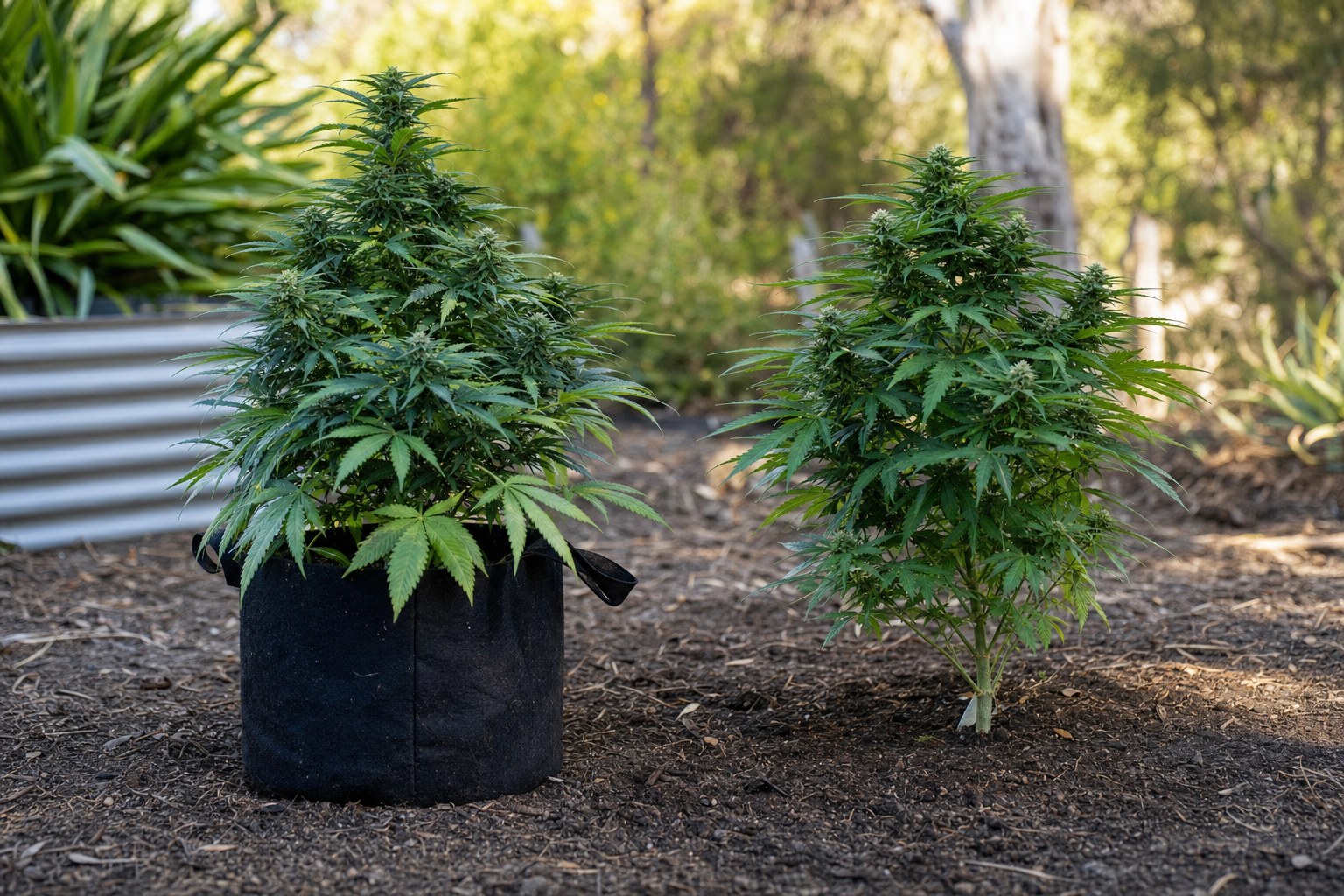
Choosing whether to grow cannabis in pots or ground depends on drainage, climate, available root space and how much control the site requires. Pots offer mobility and a more manageable soil profile, while open ground provides a larger root zone and slower environmental change. Neither option is universally better across Australia.
Key takeaways
- Pots provide control: Containers let growers select the growing medium, adjust plant spacing and move plants when conditions change.
- Open ground provides scale: Suitable garden soil offers a broad root zone with more stable temperatures and slower moisture fluctuations.
- Drainage is decisive: A well-drained garden bed may suit open-ground cultivation, while heavy clay or persistently wet soil can favour raised containers.
- Containers need closer observation: Pots heat, cool and dry more quickly than surrounding soil, particularly during warm, windy weather.
- Australian regions differ: Spring timing, rainfall, frost exposure, humidity and wind vary substantially between tropical, subtropical, temperate, arid and cool-climate locations.
Cannabis in pots and garden soil: an Australian comparison
When deciding whether to grow cannabis in pots or ground, begin with the site rather than the plant. Check how sunlight moves across the area, where water collects after rain, how strongly wind passes through and whether nearby structures cast long shadows. A sunny garden bed is not automatically suitable if it stays saturated, while a fabric pot can struggle on a hot paved surface that radiates heat.
Pots allow a grower to build a defined growing medium rather than relying on the existing soil. They are useful where the garden contains compacted clay, shallow topsoil, rubble or aggressive roots from established trees. Containers can also be repositioned to respond to seasonal sun angles, strong wind or periods of heavy rain. Their main limitation is that the entire root zone depends on a relatively small volume of medium.
Open ground can offer greater root volume and more stable access to moisture. Garden soil is buffered by the surrounding earth, so daily temperature changes usually reach roots more slowly than they do in pots. However, the existing soil needs suitable structure and drainage. Once a plant is established in the ground, it cannot be moved if exposure proves unsuitable.
Container size should match the intended growing period, available space and capacity to manage watering. A small pot is lighter and easier to move, but its medium can dry rapidly and roots may fill the available volume. A larger pot changes more gradually, although it becomes heavy when watered. Whatever the size, drainage openings must remain clear and excess water needs somewhere appropriate to flow.
Root zones differ between containers and open ground
Roots in a pot meet a physical boundary. As they reach the sides and base, their growth pattern is shaped by the container design. Rigid plastic pots hold their form and lose less water through the walls. Fabric pots expose the outer medium to more air, which can encourage a branched root pattern, but they also lose moisture faster in dry or windy conditions.
In open ground, roots can explore beyond the original planting area when soil structure allows. This broader zone may provide access to moisture held deeper in the profile. It can also bring roots into competition with lawn, shrubs or trees. Garden beds close to established vegetation may appear spacious above ground while containing dense networks of existing roots below.
Compaction restricts both container and garden roots. Potting medium can settle over time, especially if it contains very fine particles. Garden soil can become compacted through foot traffic or repeated work while wet. A crumbly structure with connected pore spaces supports drainage and air movement more effectively than a dense, smeared profile.
Avoid placing a small amount of improved soil into a narrow hole surrounded by dense clay. Water may collect at the boundary, leaving the planting pocket wetter than expected. Where the wider ground drains poorly, a broad raised bed or container can offer a more consistent root environment. Observe the site after substantial rain before making a final decision.
Drainage and soil structure vary across Australian landscapes
Australian garden soils range from deep sands to heavy clays, with loams and mixed urban fill in between. Sandy ground generally drains quickly and can lose nutrients and moisture rapidly. Clay may hold water and nutrients well but drain slowly when compacted. Loam can provide a useful balance, although local structure matters more than the label alone.
A simple drainage observation is more useful than guessing from surface appearance. After rain or irrigation, note whether water disappears evenly, runs away from the planting area or remains in puddles. Digging a small inspection hole can show whether moisture is penetrating the profile or stopping at a compacted layer. Do not work heavy soil while it is saturated, as this can damage its structure.
Container media should retain enough water for roots while still allowing excess to drain. Ordinary garden soil often becomes dense inside a pot because it lacks the structure needed for a confined root zone. A medium designed for containers is generally lighter and more porous. The pot should stand where drainage water can escape rather than remaining trapped beneath the base.
Mulch can moderate surface drying in both systems, but it should not be packed tightly against the stem. In open ground, mulch also limits direct sun on the soil surface. In pots, a modest layer can slow evaporation, though it may make it harder to judge moisture by sight. Check below the surface rather than watering on a fixed timetable.
Overwatering is not simply a matter of applying a large volume once. It more often reflects repeated watering before the root zone has used enough moisture. Pots make this easier to assess by weight: compare how the container feels after drainage with how it feels as the medium dries. In garden soil, inspect several centimetres below the surface and consider recent rain before adding water.
Pots experience faster environmental shifts than surrounding ground
A container is exposed on its sides as well as its surface. Dark pots in direct sun can absorb considerable heat, while small pots cool quickly on cold nights. The ground changes temperature more slowly because it is connected to a much larger soil mass. This buffering is one of the strongest advantages of open-ground cultivation in regions with hot days or sharp temperature swings.
Placement can limit container stress. Keep pots away from heat-reflective walls, metal fences and bare concrete during warm weather. Light-coloured outer covers or spacing that allows air movement can reduce heat absorption. Do not place a pot permanently inside a tray filled with water, as restricted drainage can leave the lower medium saturated.
Wind also affects pots more strongly. It increases water loss from leaves and growing medium, and tall plants can become top-heavy. Wide-based containers are less likely to tip than narrow ones. Open-ground plants are not immune to wind, but their roots have a broader anchoring area when soil conditions are suitable. A permeable windbreak is generally preferable to a solid barrier that creates turbulence.
Mobility is the defining container advantage. A manageable pot can be moved under cover during exceptional rain or shifted away from damaging wind. Frequent movement, however, can disturb branches and alter light exposure. Larger containers may require a trolley and a level route. Plan access before the plant and wet medium make the pot difficult to handle.
Spring from September to November differs by climate region
Australian spring runs from September through November, but calendar dates do not create identical growing conditions. A tropical September can already be warm and humid, while inland or elevated sites may still experience cold nights. Use local observations and weather information rather than assuming that spring conditions are uniform nationwide. Our Australian climate regions guide provides broader regional context.
Spring grow calendar
- September: Assess drainage, daily sun, prevailing wind and overnight temperatures. Prepare containers or garden beds without rushing into exposed conditions. In cooler districts, watch for late frost and cold soil. In northern areas, consider rising heat and humidity.
- October: Reassess sun as its angle changes and days lengthen. Check whether pots are drying faster, whether garden beds retain water after storms and whether surrounding vegetation is creating new shade or root competition.
- November: Prepare for summer heat, stronger evaporation and region-specific storm activity. Increase observation rather than watering automatically. Confirm that container drainage remains open and that supports or wind protection are stable.
Tropical and subtropical regions
Northern and coastal locations may experience warm spring weather, increasing humidity and intense rainfall events. Free-draining root zones and airflow are important considerations. Containers allow shelter during exceptional rain, but they can heat rapidly. Open ground may remain wet where clay, low spots or compacted layers slow drainage.
Temperate southern regions
Southern coastal and inland temperate districts commonly move from cool September conditions towards warmer November days. Late cold snaps, variable rain and strong spring winds can influence the choice. Pots offer flexibility, while open ground provides thermal stability once soil has warmed. Local frost history matters more than a broad regional label.
Arid and semi-arid regions
Dry inland environments often combine intense sunlight, low humidity and large day-to-night temperature ranges. Small containers can dry very quickly, particularly in wind. Larger pots or suitable open ground may change more gradually, but both need careful moisture observation. Shade from harsh late-afternoon sun can matter even when morning light is beneficial.
Cool and elevated districts
Highland and southern elevated areas can retain cold nights well into spring. Open soil may warm slowly, especially on shaded slopes. Pots warm faster in sun but lose that heat rapidly after sunset. Position, frost pockets and cold air drainage should all be considered before choosing a permanent garden bed.
Local geography shapes sun, wind and rainfall exposure
Two gardens in the same postcode can behave differently. A north-facing slope generally receives more direct sun than a shaded south-facing site, while valleys may collect cold air. Coastal gardens can experience salt-laden wind, and urban courtyards may trap heat between walls. Nearby roofs can concentrate rainfall into one area and leave another comparatively dry.
Map direct sunlight across the proposed location at several times of day. Observe morning, midday and afternoon exposure, remembering that the sun’s path changes through spring. Cannabis needs useful light, but intense reflected heat can make an otherwise bright container position unsuitable. Open ground near large trees may receive dappled light while also facing strong underground competition.
Rainfall totals alone do not describe root-zone conditions. Short, intense storms can run off compacted ground without soaking deeply, while steady rain may saturate poorly drained soil. Pots under eaves may receive little natural rain even when the surrounding garden is wet. Check each root zone independently rather than applying the same schedule across the property.
The practical choice is often a compromise. Select pots when mobility, medium control or separation from unsuitable soil is the priority. Select open ground when drainage is reliable, the position is proven and a stable, expansive root zone is valuable. A raised bed can sit between these options by offering improved structure with more soil volume than an individual pot.
Before any cultivation, check the rules that apply in your state or territory and to your circumstances. From a horticultural perspective, success begins with observation: understand the soil, track spring weather, test drainage and choose the system that best fits the actual site rather than relying on a universal answer.