

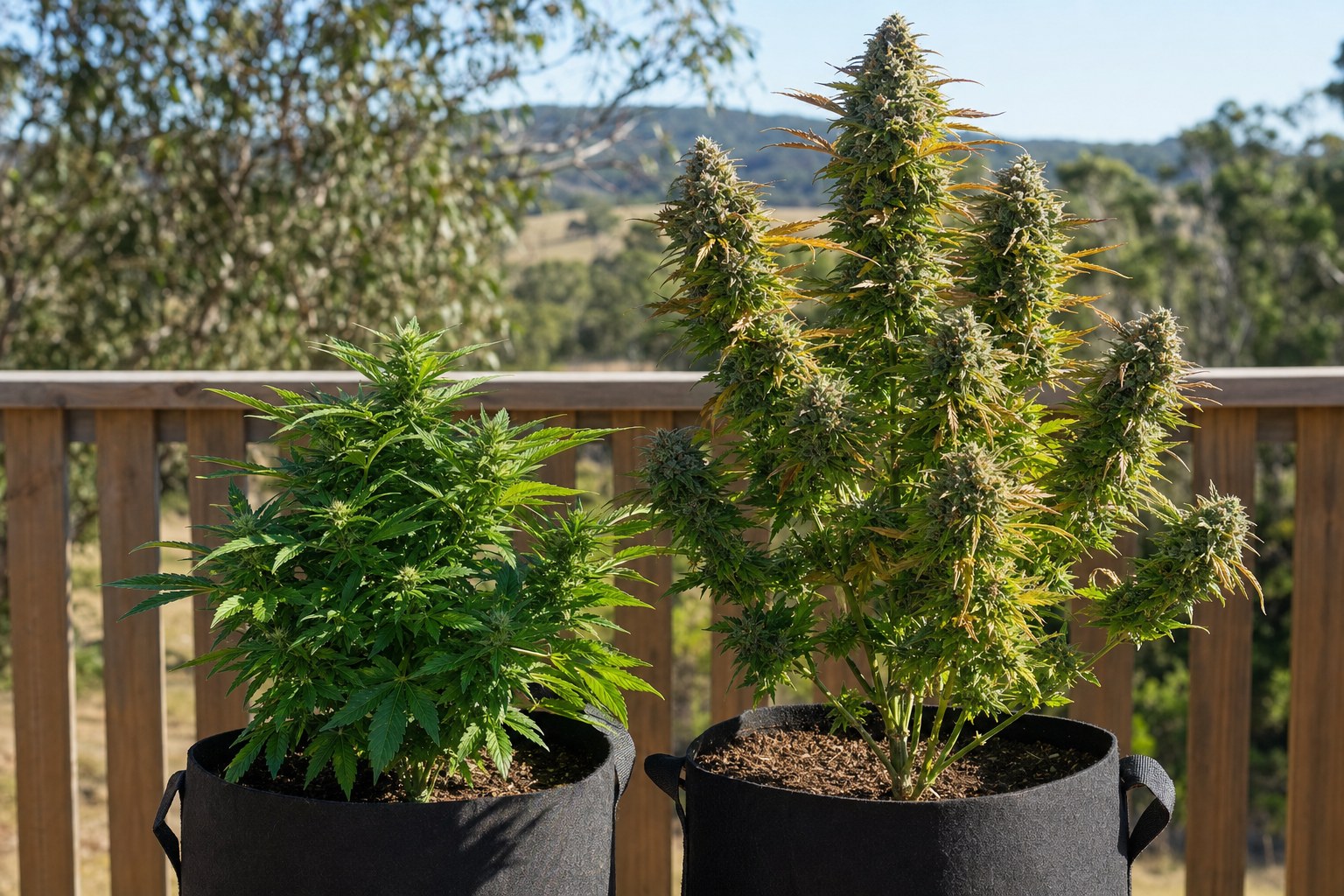
Two autoflower harvests in one Australian summer may be possible if the first cycle begins early, both cultivars have short stated lifecycles and local conditions remain suitable. It is not a certainty: weather, plant stress, genetics and legal restrictions can all change the plan. Check the rules where you live before planting.
By the Outback Seed Bank grow team.
Key takeaways
- Autoflowers flower according to age rather than a seasonal reduction in daylight, making consecutive summer cycles possible in some regions.
- Start with stated lifecycle information, then add time for germination, early growth, weather interruptions and harvest assessment.
- December may suit a first cycle in many locations, while the second cycle must be matched to late-summer and early-autumn conditions.
- Tropical humidity, southern temperature changes, inland heat and local rainfall patterns can substantially alter timing.
- Seed possession and cannabis cultivation are separate legal questions. Rules differ across Australia and may change.
- Lifecycle figures are planning estimates, not harvest promises.
Autoflower seeds in Australia: what makes a two-cycle summer possible?
People researching autoflower seeds Australia often focus on one defining feature: autoflowering plants begin flowering mainly in response to age. They do not require the pronounced shortening of daylight associated with photoperiod flowering. That characteristic can compress the seasonal plan and may allow one crop to finish while enough warm weather remains to begin another.
A two-cycle summer is best understood as a scheduling possibility, not a fixed formula. A cultivar described as taking ten weeks from emergence may need longer outdoors. Cool nights, very hot days, transplant stress, pest pressure, low light, excessive rain or root-zone issues can slow development. A sensible calendar therefore includes a buffer instead of placing two advertised lifecycle figures back to back.
The available window also extends beyond the strict calendar definition of summer. A first plant started in late spring or early December may finish during summer, with a second finishing in early autumn. Whether that remains practical depends on regional daylight, temperature, rain and humidity. Review our guide to when to plant cannabis in Australia for broader seasonal context.
Autoflowers compared with photoperiod plants
Photoperiod cannabis generally remains in vegetative growth while days are long, then transitions as the natural light cycle changes. Outdoors, this links flowering closely to season and latitude. Autoflowers use a more age-driven schedule, so a plant started in January does not normally need to wait for substantially shorter days before flowering begins.
This flexibility comes with trade-offs. Autoflowers have limited time to recover from setbacks because their internal timeline continues. Rough handling, delayed transplanting, restricted roots or unsuitable nutrition early in life may influence final size. Photoperiod plants can have a longer vegetative period in which to regain momentum, although their overall outdoor season is usually longer.
Autoflowering, feminised and regular describe different seed characteristics. Autoflowering concerns flowering behaviour, while feminised concerns the expected sex expression of the seed line. Some autoflowers are also feminised. The comparison in feminised vs autoflower vs regular seeds can help clarify these labels.
Why timing varies by cultivar, climate and conditions
Stated seed-to-harvest times are useful for comparing cultivars, but they are not countdown clocks. Different phenotypes within a seed line may finish at different speeds. Container volume, daily sun, root temperature and watering consistency also shape development. Outdoor plants experience more variation than plants grown under controlled conditions.
Use the stated lifecycle as the centre of a range. Add at least a modest allowance for establishment and weather, then consider how late the second plant could reasonably finish in your region. A cultivar described as compact and fast may fit a short window more readily than a larger selection with a longer flowering phase.
Do not rely on age alone when deciding that a plant is ready. Flower maturity should be assessed through several visible signs, including pistil changes, calyx development and trichome appearance. Our guide to checking trichomes at harvest explains how observation can complement the calendar.
Check your state or territory rules before planting
Cannabis law is not uniform across Australia. Possessing a seed, germinating it and cultivating a plant may be addressed under different provisions. Personal circumstances, location, plant numbers and cultivation method can also matter. Nothing about a seed being available or an autoflower fitting the season establishes that planting it is lawful.
Before making a summer plan, check current requirements for the state or territory where the activity would occur. Do not assume that information from another jurisdiction applies locally. Rules and enforcement settings can change, so old forum discussions or recollections are not a sound basis for a decision.
Seed possession and cultivation are separate legal questions
A common misunderstanding is that possession of cannabis seeds automatically permits germination. These are separate legal issues. Our overview of whether cannabis seeds are legal in Australia explains why intended use and jurisdiction can be relevant. The guide to cannabis cultivation law in Australia addresses cultivation as a distinct question.
Even where limited personal cultivation has a different legal framework, restrictions may apply to age, residence, plant quantities, growing location or artificial cultivation. Never infer permission from this article. Obtain current information relevant to your circumstances before taking action.
Where to find current local information
Look for the latest legislation and plain-language guidance published for your state or territory. Relevant government departments, police information pages and local legal assistance services may explain current settings. Check the date and jurisdiction of anything you read, and seek qualified legal advice if the position is unclear.
Keep legal research separate from horticultural planning. A favourable climate window says nothing about permission to grow, just as possession rules do not necessarily answer cultivation questions.
Planning around the Australian summer
Work backwards from the point when local weather usually becomes unsuitable. Then allocate time for the second cultivar’s stated lifecycle plus a buffer. Whatever remains is the practical window for the first cycle. This method is more realistic than assuming summer provides a uniform three months of ideal conditions.
Early summer: December conditions and the first cycle
December offers long days and strong sunlight across much of Australia, but local conditions differ. Temperate southern areas may still have occasional cool nights early in the month. Northern areas may already be experiencing monsoonal humidity and heavy rain. Inland locations can move quickly into extreme heat.
For a first cycle, early establishment matters because an autoflower has little spare vegetative time. If germination is lawful where you are, prepare the final container or growing position before starting. This reduces avoidable delays and repeated root disturbance. The cannabis seed germination guide outlines general establishment considerations.
Young plants need bright light, but sudden exposure to severe midday conditions can be stressful. Gradual acclimatisation, suitable watering and good drainage help maintain steady growth. In exposed areas, wind and reflective heat from walls, paving or metal surfaces may be as significant as the forecast air temperature.
Mid-to-late summer: assessing time for a second cycle
Before beginning cycle two, recalculate rather than simply repeating the December plan. Note the expected finish date, average night temperatures, seasonal rainfall and the direction of daylight change. By February, southern nights begin lengthening and may cool noticeably before a slow cultivar finishes.
Starting the second plant before the first is harvested can create an overlap that uses the remaining warmth more efficiently. However, this requires enough suitable space and must remain within any applicable legal limits. If overlap is not appropriate, wait and accept that the second finish may move further into autumn.
Late-summer flowers may face different pressures from early-summer flowers. Coastal humidity, autumn rain and reduced airflow can increase mould risk, while inland plants may still encounter hot, drying winds. Maintain space around foliage, avoid persistently wet growing media and inspect flowers regularly. Where prolonged unsuitable weather is likely, forcing a second cycle into the calendar may not be worthwhile.
Regional differences across tropical, subtropical, temperate and arid Australia
Tropical north: Warmth can support rapid growth, but summer often coincides with high humidity, intense rain and storms. Drainage, airflow and shelter from damaging weather deserve priority. A drier regional period may offer a more manageable window than the conventional December-to-February summer.
Subtropical east and west: Long warm periods may provide room for consecutive cycles, although humid spells and heavy rainfall can complicate flowering. Local elevation and distance from the coast can produce major differences. Monitor the actual conditions at the growing site rather than relying only on a city forecast.
Temperate south: December and January commonly provide the strongest combination of warmth and long daylight. A second cycle extending into March or April may encounter cool nights, rain and lower light. Faster cultivars and an early first start generally fit this region better than a late January reset.
Arid and inland areas: Low humidity can reduce some moisture-related concerns, but extreme heat, dry wind and rapid container drying create other challenges. Afternoon shade during severe conditions, larger water reserves and protection from hot surfaces may help stabilise the root zone. Cold autumn nights can arrive quickly in some inland districts.
Grow calendar: an example two-cycle summer
This calendar is a flexible planning model for a temperate or mild subtropical location, not a universal timetable. Shift it according to regional conditions and the cultivar’s stated lifecycle.
- Late November to early December: Confirm local rules, compare lifecycle ranges, prepare the growing position and begin the first seed only if lawful.
- December: Focus on uninterrupted establishment. Watch heat, wind and container moisture as summer intensity increases.
- January: The first plant may be flowering. Recheck its progress rather than assuming the original finish date remains accurate.
- Late January to early February: If conditions, space and local rules permit, begin the second cycle. Select a realistic autumn finish date.
- February: Assess the first plant using maturity signals. Support airflow during humid weather and avoid harvesting solely because a calendar date has arrived.
- March into April: Monitor the second plant for cooler nights, reduced sun and autumn rain. In warmer regions, the useful window may extend further.
Choosing autoflower seeds for a summer plan
Seed selection should begin with environmental fit. Compare the stated total lifecycle, expected height, structure, flowering duration and preference for warm, dry or humid conditions. Compact plants may suit decks and sheltered courtyards, while open branching can improve airflow in humid locations. Browse broader selection factors in our guide to outdoor cultivars for Australia.
For two cycles, shorter stated timing provides more flexibility, but speed should not be the only filter. A very fast cultivar that dislikes local humidity or heat may be a weaker choice than a slightly slower one better matched to the site. Consider available sun, container space, exposure and how conditions change toward autumn.
Compare stated lifecycle, size and environmental preferences rather than relying on harvest promises
Product descriptions are best used comparatively. Look for a lifecycle range rather than treating the shortest figure as a deadline. Check whether the estimate refers to flowering time or the entire period from emergence. These are not interchangeable measurements.
Expected size also matters. An autoflower described as taller or more vigorous may need more root space and may take longer to mature. A compact selection can be easier to place, but small stature does not automatically mean a faster finish. For an example of the information to compare, see Northern Lights Auto seeds.
Finally, build flexibility into both cycles. Begin with a regional weather window, choose cultivars whose ranges fit comfortably inside it and reassess after the first plant shows its actual pace. Two harvests in one summer can be a workable autoflower strategy in parts of Australia, but good planning means being ready to run one successful cycle instead of crowding two into unsuitable conditions.